What to remember.
- Progressive overload means increasing the challenge over time, not forcing a personal record every session.
- More weight is one method. More clean reps, useful sets, range of motion, and better execution can also show progression.
- Compare like with like: the same exercise, similar technique, and a clear rep target.
- Track each set, the exercise total, the workout, and the weekly muscle-group picture.
What is progressive overload?
Progressive overload is the gradual increase of training demand. Your body adapts to work it can recover from, so the same easy workout repeated forever eventually stops being a strong reason to change.
In practical strength training, overload can mean lifting more weight, completing more repetitions, doing another productive set, or performing the same work with better control.
The word gradual matters. A useful progression is small enough to repeat with good form and recover from before the next workout.
Why progressive overload supports muscle growth
Resistance training creates a stimulus. Recovery supplies the time and resources to adapt. Progressive overload keeps that stimulus relevant as you become stronger and more skilled.
Without progression, a once-challenging set may become routine. You can still sweat and feel tired, but fatigue alone does not prove that the target muscle received a growing training demand.
Current ACSM guidance emphasizes consistency first, then tailoring load and weekly volume to the goal. For hypertrophy, enough challenging weekly work matters more than a complicated routine.
Progressive overload is more than adding weight
Adding weight is easy to measure, but it is not always the next best move. A five-kilogram jump can be too large for a lateral raise and reasonable for a deadlift.
A progression method should fit the exercise. Stable compound lifts often tolerate load jumps. Smaller isolation exercises often progress better through repetitions before weight.
- Add one or more repetitions while keeping the same load and technique.
- Add the smallest sensible amount of weight while staying in the target rep range.
- Add a productive set when recovery and program balance support more volume.
- Use a fuller range of motion or cleaner tempo without reducing the intended effort.
- Complete the same work with a lower perceived effort after several exposures.
Use double progression to remove the guesswork
Double progression uses a rep range before a load increase. Imagine three bench-press sets in a target range of six to ten reps.
Keep the same weight until your sets reach the top of the range with acceptable form and effort. Then make the smallest load increase and work upward through the range again.
This approach gives every session a clear target. If last time was 8, 8, and 7 reps, today might aim for one additional clean rep across the exercise.
- Session 1: 80 kg for 8, 8, and 7 reps.
- Session 2: 80 kg for 9, 8, and 8 reps.
- Session 3: 80 kg for 10, 10, and 10 reps.
- Session 4: increase the load, return near the lower end, and build again.
Compare the set, exercise, workout, and week
One stronger set is useful evidence, but it is not the whole program. Exercise progress shows whether performance is moving across comparable sessions.
Workout totals show whether the session changed. Weekly muscle-group coverage shows whether chest is progressing while back, legs, or shoulders quietly fall behind.
This is why a progressive overload app should do more than store numbers. It should return the last performance at the moment you need to choose the next weight or rep target.
How quickly should you add weight or reps?
There is no universal weekly increase. New lifters may progress rapidly. Experienced lifters often need smaller jumps, longer rep cycles, and more patience.
The right pace is the fastest pace that preserves the intended exercise, rep range, technique, and recovery. A rushed increase that shortens every rep is not a clean comparison.
Daily performance also moves. Sleep, stress, exercise order, and equipment can change a session. Matching the previous workout can be a good result on a difficult day.
A simple progressive overload workout system
Choose a stable group of exercises and assign each a rep range. Record every working set, including weight and reps. Keep exercise order reasonably consistent.
Before the next set, check the comparable set from the previous session. Aim for the smallest useful win: one rep, a small load increase, or a better matched set.
After the workout, review the exercise totals and the whole session. At the end of the week, check whether every target muscle received the planned work.
- Pick a repeatable program instead of inventing every workout at the gym.
- Use rep ranges that suit the exercise and your goal.
- Log working sets immediately so memory does not rewrite the session.
- Increase only one main variable at a time when possible.
- Review trends across several workouts before changing the entire plan.
Common progressive overload mistakes
The first mistake is treating overload as “add weight every workout.” That can work briefly, then it encourages poor range of motion, unstable technique, and stalled reps.
The second is comparing exercises that are not truly comparable. A different machine, grip, order, or tempo may change the number without showing the adaptation you think it shows.
The third is chasing total volume without asking whether sets are productive. More work creates more recovery demand. The goal is enough hard training to progress, not the largest spreadsheet.
How Setz turns your gym log into a next action
Setz places your previous weight and reps beside the set you are doing. The comparison updates before you log, so you can see whether today is moving up, matching, or falling under.
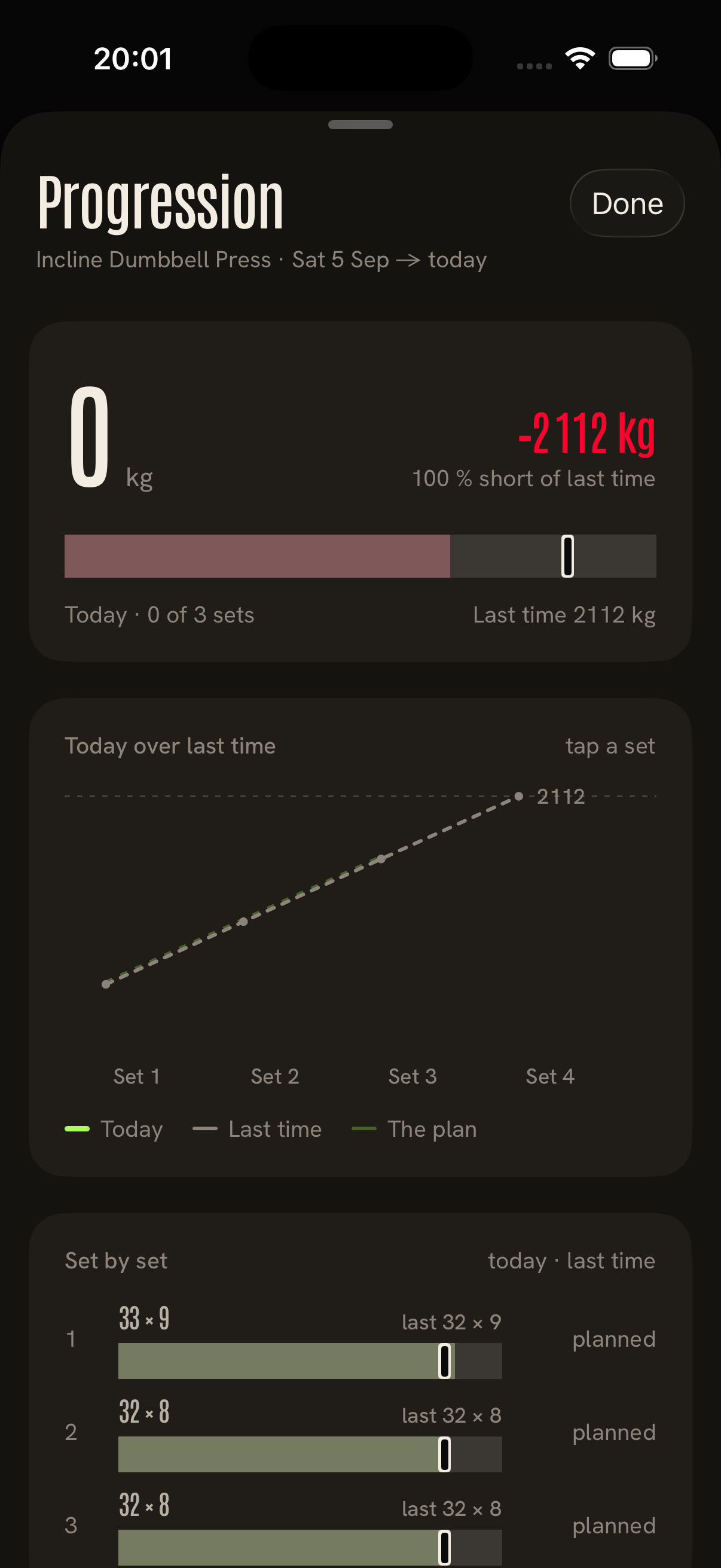
The Progression view connects each set to exercise history and a next target. The workout recap shows what moved. The seven-day muscle map shows what still needs attention.
You keep control of the training decision. Setz removes the memory test and makes the evidence readable while the bar is still in front of you.
Quick answers
Frequently asked questions.
Do I need to add weight every workout?
No. Add weight when it fits the rep range and technique. An extra clean rep, a better set match, or maintaining performance under greater control can also be useful progression.
Is progressive overload only for building muscle?
No. It is also used in strength and performance training, although the variables and progression speed should match the goal.
What should I track for progressive overload?
Track exercise, load, repetitions, working sets, and enough context to compare sessions. Reviewing exercise totals and weekly muscle-group volume makes the log more useful.
Can beginners use progressive overload?
Yes. Beginners often progress quickly with a simple repeatable program. Small, consistent increases are more useful than frequent program changes.
Evidence and further reading
Setz explains training research in plain language. These primary and authoritative sources informed this guide.