What to remember.
- A hard workout can feel productive without beating any previous performance.
- Progressive overload is necessary, but technique, useful volume, effort, nutrition, and recovery determine whether the signal becomes an adaptation.
- Diagnose a plateau from several weeks of comparable data, not one flat workout.
- Change the smallest likely bottleneck first and give the change enough time to work.
1. You train hard but do not measure progression
Sweat, soreness, and exhaustion are experiences. They are not reliable records of performance. If you cannot recall last session, every set becomes a new guess.
A training log creates a baseline. Weight, reps, sets, exercise order, and technique notes let you ask whether the same movement improved over time.
The goal is not to win every workout. The goal is to make the direction visible so a real plateau cannot hide behind random sessions.
2. Your program has no progressive overload plan
“Three sets of ten” is a prescription, not a progression model. What happens when ten reps become easy? What happens when the next weight is too heavy?
A useful program defines the next move. Double progression, rep targets, small load jumps, or planned volume increases can all work when the rules are clear.
Without those rules, lifters often repeat comfortable numbers or make jumps they cannot sustain. Both patterns can produce a long muscle-building plateau.
3. Your technique changes when the number rises
A heavier number is not automatically more overload for the intended muscle. Shorter range of motion, more momentum, or a changed setup can move stress elsewhere.
Standardize the parts that matter: machine setting, grip, stance, range, and exercise order. Perfect repetition is impossible, but comparable repetition is valuable.
If the target muscle disappears as the load rises, reduce the jump and rebuild the rep range with controlled execution.
4. Your sets are too easy—or every set is maximal
Very easy sets may not create enough stimulus. Taking every set to failure can create fatigue that damages later sets, exercises, and recovery.
Research suggests muscle growth often improves as sets finish closer to failure, but exact prescriptions remain uncertain. Training to momentary failure is not required for every set.
Use repetitions in reserve as a practical estimate. Finish most working sets with a small number of honest reps left, then adjust from performance and recovery.
5. Your weekly training volume misses the target muscle
You can complete a large workout while a specific muscle receives little direct, high-quality work. Total gym time does not reveal muscle-group coverage.
Weekly sets are a useful planning measure, but more is not always better. Evidence supports a dose-response trend while individual tolerance and diminishing returns still matter.
Track chest, back, shoulders, arms, quadriceps, hamstrings, glutes, and calves across the week. A lagging muscle often has a programming problem before it has an exercise problem.
6. You change exercises too often
Exercise variety can keep training enjoyable, but constant rotation removes the comparison. New movements improve quickly through skill, which can look like new muscle before it is.
Keep a stable core long enough to measure. Change an exercise when pain, equipment, poor fit, boredom, or a true plateau gives you a reason.
A cohesive workout program does not need to be permanent. It needs to remain stable long enough for progression data to mean something.
7. You do not eat enough protein or total energy
Resistance training supplies the signal. Food supplies material and energy. Protein supplementation research shows added benefit alongside resistance training, with total daily intake being important.
A large meta-analysis found no further average fat-free-mass benefit beyond roughly 1.6 grams of protein per kilogram per day. Individual needs still vary.
A prolonged energy deficit can impair lean-mass gains even when strength improves. If muscle growth is the goal, review body-weight trend and food consistency, not only supplements.
8. Recovery cannot support the work
Training is only one part of adaptation. Poor sleep, high life stress, and too much overlapping work can lower performance before the next session begins.
Human studies show severe sleep restriction can reduce muscle protein synthesis. That does not make one bad night catastrophic, but repeated sleep loss is a real recovery constraint.
If performance falls across several exercises, motivation drops, and soreness stays high, adding more sets may deepen the problem. Hold or reduce work before rebuilding.
9. You mistake normal fluctuation for a plateau
Strength does not rise in a straight line. Equipment, sleep, stress, hydration, and exercise order can move a single result.
Look for a repeated pattern across comparable sessions. One flat day is noise. Several weeks with no rep, load, execution, or volume improvement deserves a diagnosis.
Advanced lifters progress more slowly than beginners. A smaller improvement across a longer window can still be meaningful gym progress.
10. You cannot see which muscle group is falling behind
Exercise logs are often isolated lists. They show a bench press number but not whether pulling work vanished or leg volume became inconsistent.
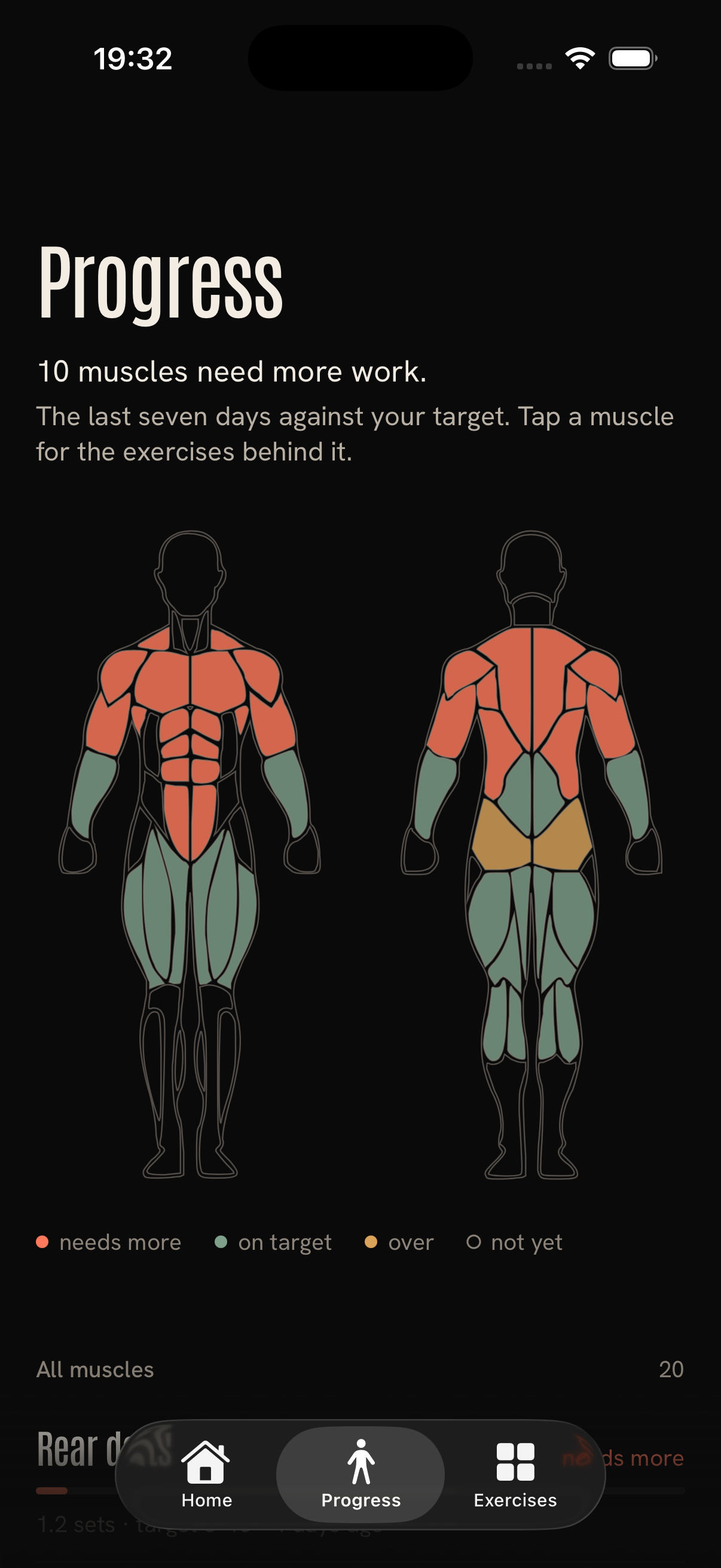
Setz connects the live set to exercise progression, workout volume, and a seven-day muscle map. You can see what improved and what still needs planned work.
That overview reduces cognitive load in the gym. Instead of redesigning the program from memory, you can correct the smallest visible gap.
A four-step muscle-gain plateau audit
Start with performance: did weight, reps, or execution improve across four to six comparable workouts? Then check whether the target muscle received consistent weekly work.
Next, review effort and recovery. Finally, review protein, total energy, and body-weight trend. Change one likely bottleneck and observe another training block.
- Performance: compare the same exercise across several sessions.
- Programming: count useful weekly sets for the lagging muscle group.
- Recovery: assess sleep, soreness, stress, and declining workout quality.
- Nutrition: check protein, total energy, and whether intake matches the goal.
Quick answers
Frequently asked questions.
Why am I not gaining muscle even though I work out?
Common causes include no measurable progression, inconsistent training, insufficient useful volume, sets that are too easy, changing technique, inadequate protein or energy, and poor recovery.
How long before I know my workout is not working?
Judge several weeks of comparable training, not one session. Beginners may see faster changes, while experienced lifters need longer windows and smaller progression targets.
Can I build muscle without getting stronger?
Muscle size and strength are related but not identical. Technique and neural skill can raise strength, while hypertrophy can occur across different loads. Long-term performance trends still provide useful evidence.
Should I add more sets when progress stops?
Not automatically. First check effort, technique, exercise consistency, nutrition, and recovery. More volume helps only when the extra sets are productive and recoverable.
Evidence and further reading
Setz explains training research in plain language. These primary and authoritative sources informed this guide.